

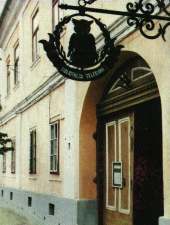
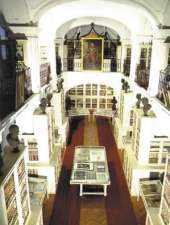
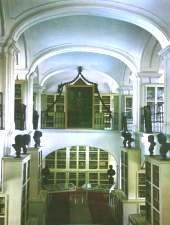
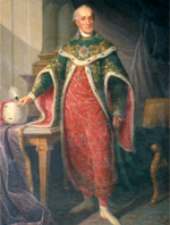
The Teleki Library (Romanian: Biblioteca Teleki-Bolyai din Târgu Mures), also known as Teleki-Bolyai Library and Bibliotheca Telekiana, is a historic public library and current museum in Târgu-Mures, Romania. One of the richest Transylvanian collections of cultural artefacts, it was founded by the Hungarian Count Sámuel Teleki in 1802, at the time when Transylvania was part of the Habsburg Monarchy, and has been open to the reading public ever since. It was among the first institutions of its kind inside the Habsburg-ruled Kingdom of Hungary.
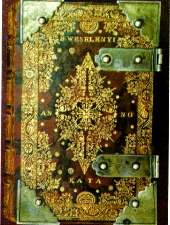
It houses over 200,000 volumes, of which many are rarities, constituting a comprehensive scientific database. The book collection is divided into several smaller libraries, of which the two main donations are the original 40,000-volume Teleki Library and the 80,000-volume Bolyai Library; the rest, grouped as the Miscellaneous Collection, is made up of several private libraries, volumes previously held by religious schools and those of a Franciscan monastery. Overall, the library constitutes a collection of most traditional types of Transylvanian book.

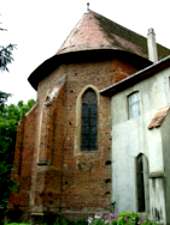
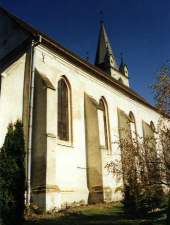
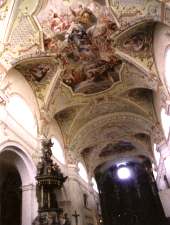
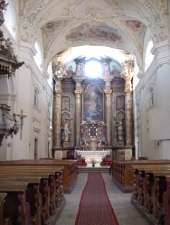
The current appearance of the inside of the church is the result of numerous changes done in time. Close to the entrance there is a balcony supported by arches on posts. The slightly curved ceiling, reinforced by four pairs of double arches and decorated with stucco, is the result of remodeling works performed in 1790 by Anton Türk, one of the most famous Transylvanian architects of the Baroque period.
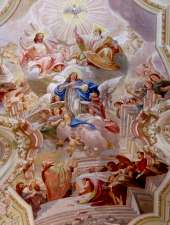
The church may have been originally decorated with frescos, as traces of mural paintings were found inside. The almost complete disappearance of these paintings is due to the fact that the church became the property of reformed believers in 1557. The religious reform required for churches to have no paintings, statues or religious frescos.
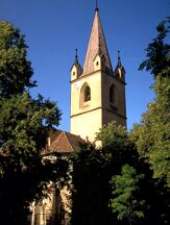
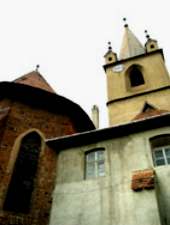
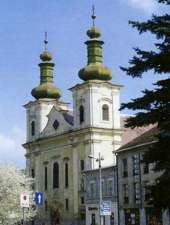
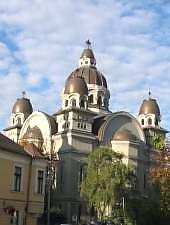
The last one to be built was the 50 meter high, 4 level steeple-tower . The top level ,where the bells are, has broken arch openings on all four sides. The pointed roof of the tower has four smaller towers in each corner. The tower may have replaced part of the monastery building, which was demolished to make place for it.
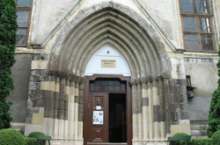
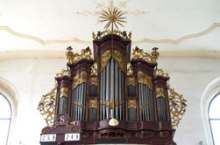
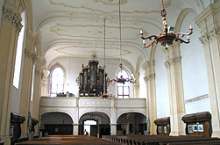
Transylvania fulfilled all the requirements for the development of this new architectural style by the beginning of the 18th century, when it became part of the Habsburg Empire. Ignatius of Loyola initiated a strong campaign to impose Catholicism as the official religion. Jesuit monks settled in the town in 1702 with the purpose of revitalizing the Catholic community. During the first years, they found lodging in the home of Boer Simon, but in 1704 managed to buy a plot of land near the Nagy Szabo house in order to build a church.When the Habsburg family in 1707 the Jesuits built a zion in the place where the church is now located. The zion was visited by Francis II Rákóczi. In 1764 because the catholic population increase a bigger church was raised.
The church was constructed based on the plans of the Jesuitan Scherzer Bálint and was raised by constructor Hammer Konrád from Cluj.
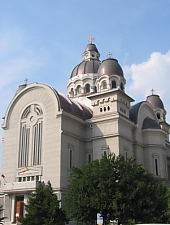
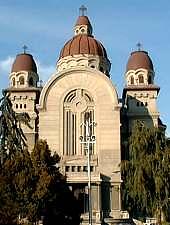
The Cathedral's cornerstone was laid on May 10, 1925, an event witnessed by, among others, the Minister of Religious Affairs, Alexandru Lapedatu, Bishop Nicolae Ivan, and Octavian Goga, who was a government minister at the time.
The cathedral was built according to the plans of architect Victor Vlad of the Polytechnic University of Timisoara, in the form of a Greek cross. The total cost of the building was estimated at 20 million lei.
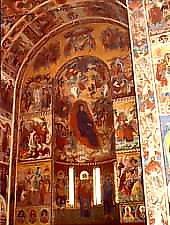
The iconostasis was built in 1934 by Traian Bobletec of Nazna, while the bells were cast at Timișoara. Due to lack of funding, murals of the interior were only completed in 1986.
The Free and Hanseatic City of Hamburg lies in Northern Germany and is both a city-state and a federal state. With over 1.8 million inhabitants, it is the second largest city in Germany after Berlin. Hamburg is known as a media and startup center, has a vibrant cultural scene and is one of the cities with the highest quality of life in the world. The Alster and the Elbe offer numerous recreational opportunities; the North Sea is just as easy to reach as the towns of Lübeck and Lüneburg. The fact that it rains more in Hamburg than in other German cities is an eternal myth. On average, with just 130 rainy days a year, we have 40 less rainy days than Munich’s citizens. As the second largest city in Germany, Hamburg offers optimal connections to all major German and European cities. Due to its size and internationality, Hamburg is very easy to reach from anywhere in the world – no matter the means of transport: bus, train, car or plane.
“Germany’s Gateway to the World” – the Harbor of Hamburg – is one of the world’s largest transshipment harbors, the third largest harbor in Europe, which makes the city one of the most important logistics locations in Europe. Hamburg’s location on the waterfront and the numerous canals that make their way through the city are just as much part of Hamburg’s cityscape as its typical brick facades. The Speicherstadt (historical warehouse district) and the Kontorhausviertel (Kontorhaus quarter) are listed as UNESCO World Heritage Sites and the Elbphilharmonie (Elbe Philharmonic Hall) became one of the city‘s main landmarks in 2017.
Hamburg is undisputedly a great city and a highly attractive place to study. With both private and state universities, Hamburg is one of the most important university cities and research locations in Germany. As a result, the city has a diverse student body and nightlife. As an educational and research location, Hamburg is the center of several prestigious educational institutions, institutes and research centers – its economic and scientific significance makes the city a top location for medical studies.
Hamburg is the third largest location for musicals in the world, after New York and London. “The Lion King” and “The Phantom of the Opera” are two classics that run continuously at the theater in Hamburg. Because of the festivals, musicals, concerts and theater performances as well as the internationally known St. Pauli quarter, there is always something to experience in Hamburg. There are no limits to leisure activities in Hamburg: the impressive Elbe Philharmonic Hall, the traditional Altona Fish Market, the Hamburg DOM as the largest folk festival in the north, the Cruise Days, the Miniature Wonderland, around 60 theaters and more than 60 museums and internationally famous galleries, the International German Tennis Championships on Hamburg’s Rothenbaum, the annual marathon, the Cyclassics and the birthday celebration of the city’s harbor are just a small selection of the wide range of sports, cultural and leisure alternatives the city has to offer.